Wednesday, April 06, 2005

LTTE attacks Naval boat off Trinco coast

A Truce Monitor on board a Navy patrol boat in the sea off Trincomalee suffered injuries, as suspected LTTE cadres, in a deliberate ceasefire violation, fired at the boat yesterday morning, Military Spokesman Brigadier Daya Ratnayake told the Daily News yesterday.

The Navy boat on routine patrol came under LTTE fire around 9.52 a.m. in the sea off Upparu, in Trincomalee.

The Truce Monitor on board the Naval boat sustained injuries while running for cover.

"It was a deliberate attempt by the LTTE to provoke the Navy since the SLMM flag was clearly visible and there was every possibility that the LTTE knew about the presence of a SLMM monitor on board," Brigadier Ratnayake added.

The LTTE cadres had fired 75 to 100 rounds at the boat from the land side in Upparu, Brigadier Ratnayake added.

SLMM monitor Alf Stoelam sustained injuries during the incident, when running for cover, the Spokesman added.

The boat, damaged in the incident was later brought to the Sri Lanka Navy camp in Trincomalee.

SLMM spokesperson Helan Olaffsdottir told the Daily News that the SLMM was yet to conclude whether yesterday's attack was a violation of the ceasefire. "We are conducting forensic investigations on the Navy boat to ascertain where the shots were fired from."

She further added that they were in contact with the LTTE ascertain as to why they fired at the Navy boat adding that they have not given any ruling on the incident. She said the presence of the truce monitor on board the Navy boat doesn't make any change towards giving their ruling.

However, she said no one was injured in the incident.

Khalid

Monday, April 04, 2005


Associated Press, Mon April 4, 2005 06:39 EDT . - - COLOMBO, Sri Lanka - (AP) At least 65 tsunami victims, including 25 children, were hospitalized in Sri Lanka - after eating uncooked grain at a refugee camp, officials said Monday.

The tsunami survivors in eastern Muttur, 230 kilometers (140 miles) northeast of the capital, Colombo, complained of dizziness and vomiting, said M. Shukri, director of the Muttur hospital.

``The patients had eaten some type of raw grain that needed to be boiled before consumption,'' he said.

They were hospitalized on Saturday. Some were discharged Sunday, while the rest were released on Monday, Shukri said.

Tens of thousands of people displaced by the Dec. 26 tsunami still remain in overcrowded camps and temporary shelters around the island. They are largely dependent on government aid.


Sri Lankan Rains Flood Tent Camps for Tsunami Survivors in East

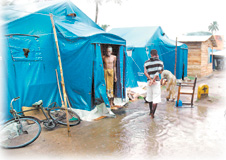
April 4 (Bloomberg) -- Rains in Sri Lanka's eastern region caused flooding in tent camps housing thousands of people made homeless by the Dec. 26 tsunami that killed about 39,000 in the South Asian island nation.

``The tent floors are wet or flooded,'' A.K. Thavarajah, a relief official for the Batticaloa/Amparai district, said yesterday, according to a report on the TamilNet Web site. ``Mats and sheets on which refugee children sleep have got soggy with the unexpected rains.''

Hundreds of people are sheltering in buildings in Batticaloa that were used to store rice and are now in a dilapidated state with leaking roofs, TamilNet said.

Sri Lanka was the worst-hit country after Indonesia by the tsunami disaster. About 17,000 people were killed in the mainly Tamil north and eastern region. The rebel Liberation Tigers of Tamil Eelam, which has been fighting for two decades for a separate homeland in the northeast, has accused the government of President Chandrika Kumaratunga of failing to provide enough aid to rebel-held areas of the island of 19.7 million people, a charge the administration denies.

About half a million people were left homeless by the tsunami that devastated coastal towns and villages.

Sri Lanka needs $.1.5 billion in aid to recover from the disaster, the Asian Development Bank, the World bank and the Japan Bank for International Cooperation said last month. About $900 million has been committed to help Sri Lanka, the ADB said last month.

Damage from the tsunami threatens economic expansion that has benefited from a cease-fire in February 2002 that halted the civil war. Sri Lanka needs to rebuild 100,000 houses, as well as ports, hotels and roads.

Peace talks between the Liberation Tigers and the government, under the Norway brokered cease-fire, have been stalled since April 2003. The civil war has killed about 60,000 people.

Khalid


TODAY'S TOP STORY

Happy at school.

Children happy in class at a small village school on the East Coast near Kalmunai
65 tsunami victims hospitalized after eating grain in Sri Lanka

At least 65 tsunami victims, including 25 children, were hospitalized in Sri Lanka - after eating uncooked grain at a refugee camp, officials said Monday.

The tsunami survivors in eastern Muttur, 230 kilometers (140 miles) northeast of the capital, Colombo, complained of dizziness and vomiting, said M. Shukri, director of the Muttur hospital.

``The patients had eaten some type of raw grain that needed to be boiled before consumption,'' he said.

They were hospitalized on Saturday. Some were discharged Sunday, while the rest were released on Monday, Shukri said.

Tens of thousands of people displaced by the Dec. 26 tsunami still remain in overcrowded camps and temporary shelters around the island. They are largely dependent on government aid.


Sri Lankan Rains Flood Tent Camps for Tsunami Survivors in East

April 4 (Bloomberg) -- Rains in Sri Lanka's eastern region caused flooding in tent camps housing thousands of people made homeless by the Dec. 26 tsunami that killed about 39,000 in the South Asian island nation.

``The tent floors are wet or flooded,'' A.K. Thavarajah, a relief official for the Batticaloa/Amparai district, said yesterday, according to a report on the TamilNet Web site. ``Mats and sheets on which refugee children sleep have got soggy with the unexpected rains.''

Hundreds of people are sheltering in buildings in Batticaloa that were used to store rice and are now in a dilapidated state with leaking roofs, TamilNet said.

Sri Lanka was the worst-hit country after Indonesia by the tsunami disaster. About 17,000 people were killed in the mainly Tamil north and eastern region. The rebel Liberation Tigers of Tamil Eelam, which has been fighting for two decades for a separate homeland in the northeast, has accused the government of President Chandrika Kumaratunga of failing to provide enough aid to rebel-held areas of the island of 19.7 million people, a charge the administration denies.

About half a million people were left homeless by the tsunami that devastated coastal towns and villages.

Sri Lanka needs $.1.5 billion in aid to recover from the disaster, the Asian Development Bank, the World bank and the Japan Bank for International Cooperation said last month. About $900 million has been committed to help Sri Lanka, the ADB said last month.

Damage from the tsunami threatens economic expansion that has benefited from a cease-fire in February 2002 that halted the civil war. Sri Lanka needs to rebuild 100,000 houses, as well as ports, hotels and roads.

Peace talks between the Liberation Tigers and the government, under the Norway brokered cease-fire, have been stalled since April 2003. The civil war has killed about 60,000 people.

Khalid


Tsunami affected Indigenous orthopaedic hospital seeks assistance

THE Pallewela Veda Medura abutting the Galle Road at Katukurunda, Moratuwa, an orthopaedic nursing institute of indigenous medicine treating indoor and outdoor patients of all ethnic denominations was hit by the ruthless tsunami on December 26 last year.

Pallewela Veda Medura, Katukurunda, Moratuwa, in addition to treating orthopaedic patients was also the laboratory for the production of local medicine, ointments, and medicinal herbal plasters used in its outlets in Sirimavo Bandaranaike Mawatha, Colombo and at Hospital Road, Kalubowila, Dehiwala.

It also housed the special X'ray equipment to investigate orthopaedic ailments. Not only locals but even foreigners sought treatment at this nursing home under emergency circumstances such as road accidents.

The sudden tsunami invasion of December 26 which submerged over 3 and half feet high within the nursing home premises swept away not only the medical equipment and indigenous medicinal accessaries but even large stocks of herbal logs stored in the laboratory by private traders.

The items swept away included patients' beds, furniture, doors and windows, bed-spreads, television sets, brass cauldrons etc.

The owner of the indigenous nursing home, Dr.R.K.Vaidyaratna, who takes great pains to preserve the ancient medical system lamented that in spite of several representations made to numerous institutions for rehabilitation assistance in respect of this devastated medical institute, nothing positive has emerged so far.

He urges benefactors to come forward to assist him as he is rendering this social service very often free of charge and devoid of any motives to earn profit.

Khalid

Sunday, April 03, 2005

Today Top Story


Tens of thousands of tsunami victims
still surviving in tents and other
temporary shelters were thrown into
more agony when heavy rain flooded
their makeshift camps.

Displaced families to receive relief coupons for two more months


Friday, April 1, 2005, 2:20 GMT, ColomboPage News Desk, Sri Lanka.

Apr 01, Colombo: The Office of the Commissioner General of Essential Services says the government has decided to issue relief coupons to tsunami victims for two additional months.

Families already receiving coupons will be eligible to claim further assistance in this form, sources said.

At present, the Office of the Commissioner General has issued relief coupons at the rate of 32 per family for a period of four months. As announced by the government, 954,110 displaced families will now be given relief for six months. The issue of coupons, which began in February, will continue until July.

The cost of the relief, Rs. 3.6 billion per month, is being borne by the government. The total amount to be spent on relief coupons will be around Rs. 22.6 billion, sources said.

This includes a coupon for Rs. 375 per month per person. From this, one is able to get Rs. 200 in cash. The balance comes in the form of food items.

Khalid

Warning : landslides with monsoon!

Peradeniya University Geologists warned a possibility of more landslides in the central hilly areas during the monsoon period due to the shaken plates of earth as a result of the spate of earthquakes erupted in Sumatra in the recent past.

Prof. Kapila Dahanayake of the Peradeniya University told the Sunday Observer that certain parts of the country, specially the central hill have experienced tremors due to earthquakes in Sumatra.

He warns people to be cautious during the monsoon period as more cracks and fractures may have occurred in the central hills. "Therefore these areas are more vulnerable to landslides", he said. When asked how to identify signs of impending landslides, he said that people should immediately evacuate if they witness any unusual muddy and warm water, falling of nuts from coconut or other trees, turning of lamp and telephone posts to one side, and also cracks in the walls of houses.

Prof. Dahanayake also noted that so far there is no equipment in the world to exactly say the date, time and the place where an earthquake will occur. Present technology can only predict an earthquake, he added.

Members of the Parliamentary Select Committee on Natural Disaster together with geologists on Thursday visited an area in Kandy which has earlier experienced an earthquake. Pahatha Hewahata Divisional Secretary Wimala Makuldeniya said that 101 families are living in a vulnerable area for earthquakes. She said that 31 families are living in the most vulnerable area in Waldabala which experienced a landslide in 1996.

When asked why the authorities have not taken steps to evacuate them, she said "earlier these people were given lands in Huruluwewa and Giradurukotte. All of them went there but after sometime many of them returned after selling those lands".

Chairman of the Select Committee Mahinda Samarasinghe MP said that the Select Committee report will propose to establish a National Centre to monitor natural disasters with the coordination of the Meteorological Department, Peradeniya University and Geological Survey and Mines Bureau.

Chairman Samarasinghe also said that new equipment should be acquired with foreign assistance and existing equipment maintained deploying trained personnel. Sighting an example he said that some equipment in the Peradeniya University has been malfunctioning during the last eight months due to the dearth of trained technicians to repair them. He said that the Select Committee report will be completed by the end of May. An Interim report will be released in April for public debate.

Khalid

Saturday, April 02, 2005

TODAY'S TOP STORY

Bread rises from Rice

A team of Japanese experts showed how bread could be made with rice flour. They met the Minister of Agriculture Anura Dissnayaka at his ministry on Tuesday. They told the minister the bread baked with white and brown rice was as good as bread baked with wheat flour. Pictured is a member of the Japanese team of experts handing over a loaf of bread to the minister.

Immediate Rs.250,000 grant to owners of destroyed houses

THE Government has taken measures to immediately grant Rs.250,000 to families whose houses have been completely destroyed in the tsunami catastrophe, Finance and Planning Minister Dr.Sarath Amunugama told the media yesterday. Owners of partially damaged houses will receive Rs.100,000 each.

On a directive of President Chandrika Bandaranaike Kumaratunga, Minister Amunugama has already instructed the People's Bank and the Bank of Ceylon to immediately provide this housing grant to the tsunami affected families to reconstruct their fully or partially damaged houses.

All the branches of the People's Bank and Bank of Ceylon in the tsunami stricken areas will be open on April 3 for the express purpose of providing funds to reconstruct houses beyond the 100 metre limit which are fully or partially damaged by the tsunami.

He said according to estimates nearly 60,000 houses damaged by the tsunami have to be reconstructed. "Of this 60,000, we presume that 30,000 houses will be accommodated under the project that the Government is launching on April 3," he told a news briefing.

Under this project all those whose houses were fully or partially damaged and located beyond the 100 metre limit will be entitled to a grant.

In a case of total destruction of a house, the owner will get a grant of Rs.250,000 which will be given in instalments with the first instalment being Rs.70,000. For partly damaged houses, it will be Rs.100,000 of which the first instalment is Rs.50,000.

"On April 3, we are inviting all those who fall into this category to the nearest bank where they already have a bank account in respect of the Rs.5,000 payment."

The first category will be those bringing a form which had been made available to them through the Divisional Secretary and the Grama Niladhari which had been issued by the TAFREN.

In the second category, this form is not fully perfected but there are certain parts filled. The third category will be for those who are not in possession of such a form but would receive it in the bank branch office and have it filled with the assistance of the bank manager and his staff.

"However all these three categories will be received by the branch bank manager. Nobody will be turned away. In order to test whether the application is genuine, the Disaster Management Team (DAT) of TAFREN had already inspected the houses and certified which are damaged fully or partially.

In addition, the Department of Census and Statistics have done a total survey and visited all these places and itemised the damage."

The Minister noted that even of all these documents are not fully completed, the victims can come to the branch offices on April 3.

The officers will help them to fill any areas which have not been filled up and they will accept it. They have time from April 3 to 8 to make sure that information is very viable in terms of what is there in the DAT report or the report of the Department of the Census and Statistics.

Finally on April 9, all those who have been now declared to eligible for these grants that is either Rs.250000 or Rs.10000 will be given a certificate which is called a confirmation of deposits. It means that the first instalment has been deposited in their bank account.

"If this program is done properly, from about April 8 or 9, about the half the number of people who need housing will be able to get resources to rebuild their houses and get them back to their normal life," he said.

A special discussion was held in this connection at the Finance Ministry on March 31 under Minister Amunugama's patronage. Ministry Secretary Dr. P. B. Jayasundera and Chairmen of the People's Bank and the Bank of Ceylon also attended the discussion.

Clear instructions will be sent by the General Managers of the two banks regarding the procedure that should be followed in respect of the Rs.250,000 grant. Each bank branch will display a banner calling for housing grant applications on April 3, Dr. Amunugama said.

The Minister noted that 10,000 copies of the requisite forms were despatched yesterday to the General Managers of the two banks - 7,000 copies to the People's Bank and 3,000 copies to the Bank of Ceylon.

From April 3 to 8, the branch managers will process them to expedite disbursements The two banks will launch an information campaign during this period on the payment stages and the categorisation of fully and partially damaged houses which will help them to understand the exact category under which they can receive grants.

Khalid

Thursday, March 31, 2005

TODAY'S TOP STORY


A renewed thirst for learning is seen among children. Here a little girl at the feet of her mother brushing up on her studies. The Government is currently having a primary education program in all schools.

Special plan to protect train commuters


The Transport Ministry is formulating a special plan to ensure the safety of railway commuters and property at a time of a tsunami.

Accordingly, trains operating on railway lines close to the sea will be taken to protected places as soon as they are notified of an impending disaster.

Transport Minister Felix Perera who met officials of the Railways Department yesterday directed them to earmark the safest spots on railway lines and keep the Railway Main Control Room informed of such places. The Minister has also directed the General Manager of Railways to appoint a committee to look into other feasible measures to protect commuters at a time of a tsunami or similar disaster.

"We have to ensure that what happened on December 26 does not repeat itself. To achieve that, the Railways Department should lay down a specific procedure to be followed during a tsunami. Co-ordination between responsible officials is essential to make decisions during such situations," the Minister said.

Minister Perera also stressed the need for a special program to protect railway workshops in coastal areas from tsunami waves.

"Following Monday's tsunami warning the authorities took swift measures to suspend train operations on the coastal railway line, take seven trains to safe places and close down railway stations," he said commending the efficiency of Department.

Over 1,500 people were killed on December 26 last year when the tsunami waves hit a Matara-bound train at Peraliya, Telwatta.

Khalid

Wednesday, March 30, 2005

Masive crowd in the Ismaic Conference in kattankudy held on 18.03.2005

Posted by Hello

Proper tsunami warning system could have prevented chaos - Experts

Monday night's stampede and chaos in coastal areas in the wake of the tsunami threat following the massive earthquake off Sumatra islands could have been prevented if there had been an elaborate tsunami warning system for the Indian Ocean.

Peradeniya University Geological Department Head Prof. Kapila Dahanayake said: "If there was a system like in the Pacific ocean where they gauge water levels with hundreds of satellite connected sensors in the deep sea and with floating buoys, an accurate reading of a tsunami could have been issued."

"This is a good wake-up call for Sri Lanka. It shows the urgent need for a proper tsunami warning system," he added.

The tsunami warning issued by the US Geological Survey following the 8.7 magnitude earthquake in Banda Aceh region, at 11.09 pm (Indonesia time) sent hundreds of residents in the coastal stretch fleeing for life. Sri Lanka picked up the warning widely covered in the International media and an evacuation alert was issued in minutes.

However, he said this was a good exercise for Sri Lankans to gauge the response of the administrative structure and the preparedness of people to deal with such a situation in the absence of an effective warning system.

Prof. Dahanayake said there was no system to measure water levels in the Indian Ocean. "Thus, making an accurate warning on whether the earthquake has actually triggered a killer wave is not possible. The tsunami is not visible in the deep sea. This was why a pre-warning had to be issued."

Monday's earthquake which recorded 8.7 points on the Richter scale possessed all attributes that could have triggered a killer wave - the magnitude was more than 7.5 on the richter scale and the depth was 30 kilometres (less than 100 kilometres) below the sea bed.

He said the motions of the quake would have been the reason for the absence of a tsunami. An earthquake must create vertical motions to trigger a tsunami. The December 26 earthquake recorded 9.2 on the Richter scale. It originated from an epicentre 10 kilometres below the seabed.

Discussions are on to set up an early warning system in the Indian Ocean with Sri Lanka and India actively taking part in the negotiations.

France, Japan and several other countries have extended their support to set up this system following the Boxing Day tsunami that killed more than 300,000 in 11 countries in the Indian Ocean rim.

The Met Department and Geological Survey and Mines Bureau officials attended a meeting held in Paris recently in this regard.

Khalid

Relief on migration to Canada for the tsunami affected

With the tidal waves destroying most of the coastal areas in Sri Lanka as well as in many other surrounding countries in the Indian Ocean, the whole world turned their eyes to the region for days following the disaster. I for one was glued to the TV almost all day during the holidays following Christmas, switching between different international news channels, and watching in disbelief, the catastrophe that shook South Asia.

I read with an aching heart an internet article written by a British volunteer medical student of Sri Lankan origin about the situation in the Mullativu hospital, the helpless situation of residents of Galle in down south, and about entire beach resort hotels being washed away along with staff and guests in many places along the coastline of the island.

These are only a few of the horror stories, which emerged following one of the greatest natural disasters the world has ever known.

I know that many Canadian citizens and Permanent Residents personally know people who were affected by this horrific disaster and to them I send my most heartfelt condolences.

On a positive note, it was heartwarming to watch the response of humankind as a whole to the diaster, with so many offering their energy, time, and money, to try to assist those affected.

Aid and donations from governments and private persons alike were flowing to the affected areas from both near and far. One can only hope that this spirit of helping those in need continues unabated as South Asia recovers from the disaster.

In response to the situation, the Canadian government immediately announced changes to its Immigration Program in order to offer relief to tsunami-affected family members of Canadian citizens and Permanent Residents following the diaster. Various relief measures were announced and information about these relief measures have bene posted on the Citizenship and Immigration Canada website (www.cic.gc.ca) with foll free numbers set up to contact for assistance.

One of the changes announced by the government is that all Family Class sponsorship applications and applications of Dependants of Refugees who were affected by the disaster will now be fast tracked.

As well, if a Canadian citizen or Permanent Resident who has a relative in the Tsunami affected areas that falls within the definition of a member of the Family Class (such as parent, grand-parent, spouse, child, orphaned niece or nephew, etc) and if you wish to sponsor your Family Class relative, such cases too will be processed on a priority basis.

Moreover, in cases where your relative does not fall within the definition of Family Class (for example an adult sister or brother, etc.) they may make an application for permanent residence in Canada on Humanitarian and Compassionate grounds provided that their Canadian relative is willing and able to provide an undertaking of financial support.

Finally, another form of relief granted by Citizenship and Immigration Canada is that tsunami affected applications and sponsorships will be fee exempted.

While anybody can make an application on Humanitarian and Compassionate grounds, the CIC website stresses that applicants must meet certain criteria to merit consideration for special relief. Such criteria require that the applicant be directly, personally and significantly affected by the disaster.

A word of caution however for the interested applicants. I expect that the Canadian High Commission will be carefully scrutinizing the applications of persons who claim to have been personally and significantly affected by the disaster.

I also expect that the High Commission will be taking steps to verify the authenticity of every piece of information provided in support of such claims. As there is a lot of fraud involved in the immigration industry and as there are unscrupulous individuals waiting to capitalize on times such as now, the Canadian High Commission will be extra careful to keep fake claims at bay.

The disaster undoubtedly was unprecedented. Don't you think the response from the world at large was unprecedented too?

For more information, you may surf the Citizenship and Immigration website.

Khalid

TODAY'S TOP STORY

A fearful night is over

A man returns to his humble shack carrying his meagre belongings after spending the night away from the Dehiwela beach following Monday’s earthquake off Sumatra that triggered panic across South East Asia.

Tuesday, March 29, 2005

Warning to residents of coastal areas

Another massive earthquake with a 8.7 magnitude was recorded off the Sumatra coast in Indonesia at 10.09 p.m. Sri Lankan time, (16.09 G.M.T.). The earthquake had not resulted in any tsunami as at midnight last night. When contacted, IGP Chandra Fernando said that the Police had taken measures to evacuvate all residents on the coastal belt from midnight last night.

The Government also advised the people to seek shelter in safer areas and areas with a higher elevation. President Chandrika Bandaranaike Kumaratunga last night over the electronic media requested people living on the coastal belt to move two kilometres inland and get to safer places.

An Army spokesman said last night that if Sri Lanka were to be affected by any tsunami, it would have occurred within three hours of the earthquake.

A Meteorological Department spokesman said that this 8.7 magnitude earthquake was powerful enough to cause a tsunami.

Khalid

Monday, March 28, 2005

Boats and fishing gear donated to tsunami affected fishermen

On an initiative of the Southern Province Governor Kingsley T. Wickremaratne, an Organization called AIDER which is an Agency of the Municipality NICE, France donated boats and a stock of fishing gear worth Rs. 1.2 million. The items were distributed with the Governor's participation, among the fishermen of the village of Morampitagoda, Galle at a ceremony held at the Governor's Office in Galle with the participation of Chandima Weerakkody, the Chairman, SDA, and SPC Member Nissantha Muthuhettigamage.

The French team who arranged this donation was active in the Habaraduwa area helping the affected people. They also built 15 houses in the area.

While they were working in the Moneragampitiya Village, Galle, the team had an opportunity to meet H.E., the President too and discussed their project details with Her Excellency and promised to visit again to help in the development of the village. The French team was coordinated by Junior Chamber International Chapter in NICE France with the Junior Chamber International Members of the Dehiwala Chapter.

Khalid

TODAY'S TOP STORY

Lanka beats world with egg

The proud owner displays the world’s biggest egg.

A Sri Lankan hen cracked the world record for the world’s biggest egg. She had laid an egg weighing 175 gms - six gms heavier than the previous best reported from northern Germany.According to the newest world record holder’s owner, Nilupul Disna Fernando, a resident of Katuneriya, she had laid an egg weighing 165 gms a week before producing the big one on March 12. A normal egg weighs approximately 65 gms.

Sunday, March 27, 2005

TODAY'S TOP STORY


HIKKADUWA SRI LANKA : Sri Lankan school chilren stand in a queue as they wait for a free lunch offered by a charity organisation 26 March 2005 at the tourist resort town of Hikkaduwa in southern Sri Lanka as the region marks the three-month anniversary of the December 2004 tsunamis that killed nearly 400 people in the town. Nearly 31,000 people were killed in the 26 December 2004 natural disaster.

Post tsunami reconstruction apace

There were distribution of 1000 transitional houses to Internally Displaced Persons due to tsunami in Trincomalee District, on the March 26th , 2005 in order to commemorate the three-month anniversary of the tsunami.
"This will be followed by distributing another 5600 transitional houses, before the Sinhala and Hindu new year festival", according to the Government Agent of, Tricomalee, Mr. Gamini Rodrigo.
Stromme Foundation of Norway is currently focusing on livelihood restoration and also in the education sector. Their programme covers eight Districts in the North, East and the South and as its first initiative 500 micro finance loans were disbursed to a number of tsunami affected families in order to recommence their livelihood.
They have also made arrangements to help a number of poor fishermen by giving them canoes to get back to their livelihood of fishing. In addition, the Stromme Foundation provided dry rations, kitchen utensils, mats, pillows, lanterns, etc., to tsunami affected people who were leaving the welfare centres.
They implemented a unique system called "cash for work" to those who were affected, by way of giving them Rs. 500 per day up to 10 days, in order to restore their partly damaged houses.
Number of families benefited from this were 610 to the value of Rs. 2.5 million. In Batticaloa District, 600 temporary houses and the same number of toilets are being built to commemorate three-month tsunami anniversary.
Under the Economic Recovery Programme of Stromme Foundation, they have made arrangements to help 1200 poor coir rope makers in Ahungalla, by distributing coir rope making machines to them. This programme will be held at Keththarama Temple in Ahungalla on March 28th 2005 commencing 9.30 a.m.
There will be a video conference between citizens in Sri Lanka and citizens in the United States of America and Australia to discuss the tsunami relief effort.
This will take place from 8 a.m. to 10 a.m. on March 29th, Colombo time and is intended to commemorate the three-month anniversary of the tsunami. This will take place at the Distance Learning Centre at No. 28/10, Malalasekera Mawatha in Colombo 06.
This videoconferencing is part of an ongoing initiative by a coalition of U.S. citizen groups and international relief organizations called "Partners for Progress". Partners for Progress seeks to sustain the visibility of voices from the tsunami-affected regions over the long-term to ensure that there is long-term awareness of and support for rebuilding in the region.
According to the agenda of the video conference, time will be allocated for introductions from various cities of the U.S.A and Australia, with expressions by individuals at each site of their community's concern for the people affected by the tsunami.
Further, there will be presentations by several people in Sri Lanka giving an assessment of the situation here three months later and explaining in terms that the general public can understand what the needs are on ground and how the U.S. and Australia can help. In this part, there will also be a discussion of how U.S. and Australian students can spend their summer in Sri Lanka helping the country as it continues the rebuilding process.
Khalid

Canada frowns on LTTE

Child conscription :
For the first time in its history, the Federal Parliament of Canada has taken up the child conscription issue in Sri Lanka for discussion.
The statement made at the Sub Committee meeting was significant because it was the first time that the issue of child soldiers in Sri Lanka was formally taken up at the Federal Parliament of Canada, a press release issued by the Foreign Affairs Ministry stated.
The Canadian Parliamentary Sub Committee on Human Rights and International Development has stressed that the Canadian Government should address the issue of the LTTE's child recruitment and ensure that Canadian funds are utilised for child protection initiatives and prevention of LTTE child conscription.
In a statement issued after a meeting on March 23, Committee Chairman and MP David Kilgour said that the international community has raised major concern over the violation of the human rights of Sri Lankan children by the LTTE and the UN Security Council has discussed it in this regard.
According to UNICEF, the LTTE has even reached the government controlled areas and strengthened the recruitment drive after the ceasefire began in 2002, Kilgour, who was also former Secretary of State Asia Pacific of the Foreign Affairs Department said.
UNICEF documented 3516 cases of child recruitment by the LTTE during the ceasefire. The recruitment became so intense that less than 50 percent children went to school as many parents kept children at home in fear of the LTTE taking them away on the way.
The statement said that children who lost their parents in the recent tsunami are more susceptible to LTTE recruitment now and Canada must address this issue and ensure its funds should meet the objectives, recruitment prevention, child protection, in all areas including tsunami affected areas, relief camps and orphanages.
Deputy Chairman Stockwell Day, Foreign Affairs Critic of the Official Opposition Conservative Party of Canada referred to the LTTE's 'horrendous act' of training children to become human bombs.
He said that he raised this issue in the House of Commons and called upon the Sub Committee to act on a non partisan basis and address the child right violation by the LTTE in Sri Lanka.
He also referred to the necessity of listing the LTTE under the Canadian Anti terrorism legislation. Federal MP Joe Comartin of the New Democratic Party said that a group of Canadian parliamentarians accompanied him to Vanni recently and expressed Canada's concern over the child conscription to the LTTE.
Khalid

Law students honour two illustrious law teachers


Two distinguished legal luminaries Prof. Lakshman Marasinghe and Justice Saleem Marsoof P.C. will be honoured at a ceremony on Tuesday March 29 at 3 p.m. at the Law College Auditorium.
It will be part of the inaugural meeting of the Law Students' Muslim Majlis, which will be followed by a Symposium on the topic 'Monogamy, Polygamy and Bigamy: Some Reflections on the Abeysundere Decision' at which Prof. Marasinghe and Justice Marsoof will be the main speakers. Both speakers have contributed to the development of law through their books, book chapters and articles, and have also written comments on the controversial decision of the Supreme Court in the Abeysundere case which sought to overrule the decision of the Privy Council in the famous Reid case.
The students will felicitate Prof. Lakshman Marasinghe who has been an Emeritus Professor of Law at the University of Windsor, Ontario, Canada, and a Director of the Secretariat for Coordinating the Peace Process, on his recent appointment as the Chairman of the Law Commission of Sri Lanka.
Having had his early education at Royal College, Colombo, Prof. Marasinghe commenced reading for a medical degree at the London Hospital Medical College, but suddenly switched to the study of law at the University College, London from where he obtained his Bachelor of Laws degree with First Class Honours in 1961, and his Master of Laws degree with Distinction in 1963.
He was thereafter awarded the Ph.D. degree by the University of London and the LL.D degree (Honoris Causa) by the University of Colombo. Since 1964 Prof. Marasinghe has been teaching law at several leading Universities abroad, but in 2002 when the Diploma in International Trade Law program was commenced at the Sri Lanka Law College, he was selected to head the local faculty. He also teaches in the University of Wales LL.M in International Trade Law program conducted at the Law College.
Justice Saleem Marsoof P.C., will also be felicitated on his recent appointment as a Judge of the Supreme Court.
He was admitted as an Attorney-at-Law in mid 1974 and joined the Attorney General's Department in September 1975 where he served for 29 years before being appointed as the President of the Court of Appeal.
In July 1998, he was made a President's Counsel in recognition of his eminence in the Bar. Justice Marsoof, who had his education at Zahira College, Colombo and Royal College, Colombo, is a Law Graduate of the University of Ceylon, Colombo where he excelled academically winning the Gate Mudaliyar Edmund Peiris prize and the Law Scholarship.
The felicitation ceremony will be chaired by the President of the Law Students' Muslim Majlis, Althaf Marsoof, who will make the welcome speech. Dr. Joe Silva, Principal of the Sri Lanka Law College, who is also the Patron of the Majlis, will deliver the inaugural address.
The felicitation speeches in honour of the two distinguished teachers of the Law College will be made by two students of the University of Wales LL.M program, State Counsel Rajiv Goonetilleke and Ranjan Sriskantha, Attorney-at-Law.
Khalid

Saturday, March 26, 2005

No 'de facto' recognition of LTTE

THE Government could sign a deal brokered by Norway with the LTTE to provide a formula for distributing tsunami relief as long as it was not seen as giving the LTTE de facto recognition as a Government, Foreign Minister Lakshman Kadirgamar said.

Addressing the Foreign Correspondents Association (FCA) in Colombo over the weekend, Minister Kadirgamar said: "I am told that the process of a joint mechanism is moving. It is not standing still. It is not going backwards."

The Foreign Minister said the Government's main objective now was to enter into a joint mechanism with the Tigers to distribute foreign aid for tsunami victims in the North-East, some parts of which are held by the LTTE.

Nearly 31,000 people were killed in Sri Lanka by the December 26 tsunamis and two thirds of the victims were in the Northern and Eastern regions.

He ruled out an early resumption of peace talks. "A formal resumption of the peace process is very much on the backburner," Kadirgamar told the FCA meeting.

Peace talks have been stalled since April 2003. Despite the suspension of face-to-face discussions, the two parties are abiding by a ceasefire arranged by Norway and in place from February 23, 2002.

The LTTE earlier this month said they agreed to the joint mechanism proposed by Norway, but there has been no formal announcement on the exact contents of the proposed deal.

An agreement on distributing tsunami aid is needed because international donors and several Governments do not want to give aid directly to the Tigers who are designated a terrorist organisation by countries such as the United States, Britain and India.

Khalid

International community in Beijing helps Lankan tsunami orphans

PROMPT and official assistance from the Government of the People's Republic was received in cash, kind and relief services following the tsunami disaster which affected Sri Lanka.

The people of China including the Special Administration Region of Hong Kong have contributed over Rs. 165,000,000 towards relief efforts through organisations like the China Charity Federation, the China Red Cross, the China Disabled Persons Federation, World Vision as well as private donations from schoolchildren, artists and entertainers.

A special display and sale of Sri Lankan gems and jewellery was organised by the Embassy of Sri Lanka in Beijing on March 04.

For the specific benefit of the Sri Lanka Foreign Ministry Seva Vanitha Project for a Children's Home in association with SOS Children's Villages.

Wives and daughters of ambassadors and diplomats of several countries and international organisations accredited to Beijing participated. They modelled jewellery designed by the Chinese company, Lordspek International made with Sri Lanka gems, as well as Sri Lankan-made traditional and contemporary jewellery.

The wives of Ambassadors of Albania, Algeria, Austria, Canada, Croatia, Cyprus, Iceland, Morocco, Italy and the United States of America wore their own national dress with matching Sri Lankan jewellery and gems.

With their Sri Lankan jewellery, wives of Ambassadors of Bangladesh, Chile, Estonia, Malaysia, Mozambique, Singapore and Sweden wore Sri Lankan sarees. They included the "upcountry" saree, the Kandyan saree and the saree worn in Tamil style.

Wives of representatives of the World Bank, the WHO and CNN also modelled. The daughters of the UN Resident Representative in Beijing wore bridal sarees and the traditional Sri Lankan jewellery, representing both the Sinhala and Tamil communities. The wife of the Indian Ambassador was the compere.

Chinese film star Xu Jinglei who won the Best Directors Award at the San Sebastian Film Festival last year also volunteered support for the Sri Lanka project and tsunami relief. She expressed her interest in promoting Sri Lankan tourism and will visit Sri Lanka soon.

Xu has been designated Honorary Goodwill Ambassador for the Sri Lanka Tourist Board. Apart from being the lead actress in the award winning film. Letter from an Unknown Woman, she is also its producer, script writer and director.

Jewellery specially designed for her in the film is to be auctioned as a further benefit for the Seva Vanitha project. Cathy Mao of Lordspek International made a presentation with Chinese models displaying uncut Sri Lankan gems.

She explained the value and special characteristics of Sri Lankan gems, tracing the history of Sri Lanka's gem trade with China from at least the time of the Tang Dynasty.

A raffle held on the occasion netted proceeds of over Rs. 580,000. Prizes were return air tickets to Sri Lanka, Europe, ladies' wrist watches and premium quality Sri Lanka tea.

Video clips, courtesy of Rupavahini, featured children in Sri Lanka recovering from the tsunami and clips of Baby 81.

Dharmadasa Wanniarachchi, Governor, North Western Province and R.D. Wimaladasa, Provincial Minister of Agriculture were present as special guests with their delegation. They were in transit in Beijing on their way to Shangdong Province on the invitation from the Governor of Shangdong.

Among the invited audience of over 300, were senior Chinese Government and Red Cross officials, diplomats, business people and members of the media.

Khalid

Tsunami: Three months on

AT 0758 local time on December 26 last year, exactly three months ago, the Earth's crust deep under the sea off the west coast of Indonesia's Aceh province shifted violently, lifting the seabed by some 15 metres.

The seismic thrust, the world's biggest in 40 years measuring 9.0 on the Richter scale, sent shockwaves through the Indian Ocean, unleashing tsunamis speeding at up to 700 kilometres per hour in every direction. Wherever they hit they wrought devastation as never before. It was the worst natural calamity in living memory.

The death toll: The number of people believed to have perished in the disaster stands at more than 273,000. Indonesia was the worst hit country, with 126,715 dead and 93,480 listed as missing.

Sri Lanka lists 30,957 as dead, with 5,637 missing. India, Thailand, Maldives, Malaysia, Myanmar, Bangladesh, Somalia, Tanzania, Kenya were among the other affected countries.

The homeless: In Sri Lanka alone, up to one million people were displaced. Around 500,000 people remain in camps or temporary shelter. There have been no major outbreaks of disease.

Relief: An unlikely coalition of more than 25 nations banded together to help stricken tsunami victims, with troops and military hardware being deployed by countries including the United States, France, Pakistan, Japan, China, Jordan, India, Brunei, Britain and Russia.

Most troops have now withdrawn. Many high profile figures also toured the tsunami-hit region.

Donations, pledges: Countries around the world pledged up to 10 billion dollars in aid.

The UN says some 90 per cent of its 977 million dollar flash appeal to cover the first six months of relief for the disaster has been covered.

It is unclear how much money will eventually reach areas in need of reconstruction and rehabilitation. Officials in Colombo say that of more than 884 million dollars in pledges to Sri Lanka, it had received US$ 95.5 million.

Economic cost: Despite the massive death toll, the economic cost of the disaster will be relatively light since major industrial zones were not touched by the disaster.

Sri Lanka has said reconstruction work and foreign aid will more than offset the economic losses and revised its economic growth forecasts for 2005 upwards to around 5.5 percent.

Khalid

Sunday, March 20, 2005

Murali starts new innings in India

Mathimalar Ramamurthy and Muttiah Muralitharan will enter matrimony at the Rani Meyyammai Hall at Egmore, Chennai this morning amidst a host of Indian and Sri Lankan invitees.


He has claimed the scalps of many top-class batsmen with his crafty deliveries, but he took some time to bowl a maiden over. Muttiah Muralitharan has finally found the perfect partner for his life's innings.

Muralitharan found her not on home turf, but in the sunny climes of neighbouring Chennai.

Mathimalar Ramamurthy and Muralitharan (above) will enter matrimony at the Rani Meyyammai Hall at Egmore, Chennai this morning amidst a host of Indian and Sri Lankan invitees.

Finance Minister Dr. Sarath Amunugama will be among the special invitees while former World Cup winning captain Deputy Tourism Minister Arjuna Ranatunga, who staunchly defended Muralitharan throughout the infamous chucking episodes in Australia and elsewhere, will sign as a witness. A number of team mates of Muralitharan, including Captain Marvan Atapattu, are also expected to attend. Several former Indian Test players and top politicians from Tamil Nadu will also grace the ceremony.

Murali's surgeon Dr. David Young is also among the invitees. A separate reception will be held at a leading hotel in Chennai tomorrow. Spin wizard Muralitharan is just behind Australian Shane Warne in the world bowling record stakes. Dr. Amunugama is due to meet top Indian leaders after the wedding.
Khalid

Tsunami early warning system - how it works

The writer on the 20km long coastal levee along the Fuji Coast of Japan constructed as a barrier for preventing tsunami from reaching the populated inner coastal region.

Tsunamis or earthquakes can be neither prevented nor predicted. An early warning system that can give sufficient hours of advance notice to coastal communities is a primary way of effective mitigation of this disaster.

Water level gauges are an essential element of a tsunami warning system. They can be used to confirm the generation of tsunami waves following an earthquake. To be effective for warning purposes, water level gauges should be located near the tsunami source region to get the most rapid confirmation of the event. Forecasting tsunamis requires adequate understanding of the phenomenon, good and quick collection of earthquake and sea level data and accurate and fast assessment and interpretation of data.

A tsunami warning centre such as that in operation around the Pacific ocean could have saved thousands of people who died in the Indian Ocean earthquake. Both Sri Lanka and India did not have such a facility mainly because large tsunamis were in the past extremely rare in the Indian Ocean.

In the Pacific Ocean a few tsunamis are reported in any given decade. Between 1975 and 1998 there have been at least eighteen (18) in the Pacific and the adjoining seas resulting in significant human casualties and damage to property. In countries like Japan or USA, people living in coastal areas of the Pacific Ocean where more than 90% of all tsunamis recorded have occurred in the past, are warned and taught to move away from coastal regions after a tsunamigenic earthquake. The Pacific Tsunami Warning Center (PTWC) operated by the US in Hawaii and supported by 26 member countries, including Australia, Canada, Chile, China, Japan, USA etc., has many seismic stations, water level reporting stations and dissemination points scattered in the Pacific Basin. Functioning of the system begins with the detection by any participating seismic laboratory of an earthquake of sufficient size to trigger alarms, set at the threshold value of 6.5 on the Richter Scale. PTWC collects seismic data, locates the earthquake and computes its magnitude. When reports from water level stations show that a tsunami has been generated posing a threat, a warning is transmitted to the relevant dissemination centres within shortest possible time.

Japan is located in the circum Pacific tectonic zone where seismic activity is extremely high. Japan being an island nation surrounded by sea is one of the most tsunami-prone countries in the world. Since 22,000 people died in the Sanriku Tsunami of 1896 and another 3000 in 1933, Japanese Meteorological Agency (JMA) has been in the forefront of providing tsunami warnings for more than 100 years.

Over the years, JMA has been able to reduce the target time of tsunami warning to just 3 minutes since 1994 by using state-of-the-art technology. JMA has improved its seismometer networks (numbering more than 180) and seismic data processing by getting rapid estimation of magnitude of earthquake and location and observing sea level changes using tidal data from more than 100 stations. Even the most modern computer will require much time to study tsunami generation and propagation. JMA has calculated tsunami generation and propagation for 100,000 different simulated cases and obtained estimated tsunami heights and arrival times which are stored as a database.

Essential elements
Minimal information required for tsunami warning constitutes time of origin, location, magnitude and depth of earthquake (hypocentre) and tidal data giving sea level rise. Principal components are the following:

* Network of seismic stations to observe seismic waves * Tidal stations to monitor sea level changes * Dedicated telephone lines to transmit observed data in real time * System to determine immediately the hypocentre and magnitude of the earthquake * Evaluation of possibility of generation of tsunami using sea level changes obtained from tidal stations via satellite * Communication network to disseminate warnings to mass media , local authorities, police and eventually to residents at risk.

Once the tsunami warning is rapidly communicated to people at risk they should be able to respond positively without panicking.

For smooth evacuation in potentially danger areas, prior to the event it is essential to (i) conduct awareness programmes about tsunamis (ii) prepare hazard maps giving previous heights of tsunamis (iii) identify evacuation routes and shelters and (iv) conduct evacuation drill practices periodically for schoolchildren and villagers at risk.

Continuous effort is essential for education and training since people tend to forget the dangers as probability of tsunami occurrence in the Indian Ocean countries particularly is low if old records are any indicator.

In the aftermath of the massive and disastrous tsunamigenic earthquake of 26/12 we have to learn from the long and successful post-tsunami experiences of the Pacific Rim countries and take appropriate steps to establish a tsunami warning facility in Sri Lanka / SAARC region and be prepared for any possible future threat from the Indian Ocean. It should be noted that the geological conditions of the occurrence of earthquakes in the Indian Ocean region are different from those in the Pacific Ocean. It is necessary to recognize the type of tsunami -local or distant or both - that could attack the countries in the region. If there is no risk from local tsunamis, it would be sufficient to establish a system to monitor a tsunami warning from a regional Tsunami Warning Center 24 hours a day and each country could determine its responsibility and initiative and decide if a warning should be issued or not.

Although research studies indicate that the probability of an immediate repetition of a tsunami is low from the same location of the earthquake, there is always the possibility of an earthquake from a different location.

Past records and years of earthquake research have shown that it is not yet possible to predict with precision the exact date and time of earthquakes even with modern equipment available in countries like USA and Japan. Present thinking is that an earthquake can happen anywhere anytime. Same is true for tsunamis. But with a tsunami warning system in place, most people will have time to evacuate to high ground or safe locations (e.g 3rd floor or above of nearby strong buildings- ideally reinforced concrete buildings) unless the earthquake occurred very close to the coast.
Since the minimum period required to give warnings about tsunamis currently is three minutes, it may be too late for residents of such coastal areas by the time they receive the warning.

Therefore they should run immediately to high ground if they feel a strong earthquake had occurred as judged by strong earth shaking and damage to houses. Even in countries like ours, until the tsunami warning system is established - which may take a considerable period of time- people living in coastal areas should be on high alert if they feel a strong earthquake and run to high ground or to 3rd floors or above (considering the height of the previous tsunami) of strongly built houses of the vicinity.

Awareness and education programmes are sometimes more effective than sophisticated and expensive warning systems.Such programmes also can save hundreds and thousands of human lives. In this regard it is essential that measures are taken to include Disaster Management and Mitigation as a subject in the school curriculum so that awareness programmes will continue without much effort.

(The writer was recently in Tokyo attending a Workshop on Tsunami Early Warning Systems and conducted field visits to tsunami preparedness facilities in Numazu City, Shizuura District).
Khalid

Kadirgamar at UN Human Rights Commission

Foreign Minister Lakshman Kadirgamar

SINCE its establishment in 1946, as a functional Commission of the ECOSOC, the Commission on Human Rights has continued to heed the voices and sentiments of the countless numbers of the aggrieved as well as the representations of almost all member and observer States of the United Nations. This attention and focus have had their negative and positive repercussions. On the positive side, the goal of promotion and protection of human rights is now both a cross-cutting and integrated item on the UN agenda. No State can be oblivious to its widening ramifications and consequences. In turn, this wider focus and attention has resulted in greater calls for the Commission on Human Rights to deliver on its mandate in an equitable and fair manner. In fact, such criticism has reached a stage where the credibility of the Commission on Human Rights is now at stake. This issue has no doubt gained the attention of Secretary General Kofi Annan as evidenced by the appointment of the High Level Panel on Threats, Challenges and Change which has now submitted its report.

The report of this High Level Panel appointed by the Secretary-General has proposed far-reaching structural changes in the Commission. Sri Lanka is of the view that these proposals merit careful consideration and that any reform should be pursued in a comprehensive and balanced manner, which should also lead to the strengthening and revitalization of the principal organs of the UN such as the General Assembly and ECOSOC.

I am addressing this Commission at a time when my government is making a concerted and determined effort to rebuild a nation faced with the calamitous event that occurred on 26 December 2004, just over two months ago, when fatal waves suddenly struck the southern and eastern coasts of Sri Lanka with unimaginable ferocity. It took away thousands of innocent lives and massively destroyed infrastructure along the coast.
The government moved into action within less than one hour and commenced the distribution of food and other relief items to the North, South, East and West, without any discrimination whatsoever.

The armed forces, the Police and the entire public service toiled unstintingly through day and night. Within a month detailed plans were formulated for a reconstruction programme - building houses, schools, hospitals, roads, railways, fisheries harbours, the power and telecommunications supply. The government apparatus for the distribution of supplies is effectively in place.

Soon after the tsunami struck our nation, the world came to our assistance in an unprecedented manner. Many Governments, the United Nations and other inter-governmental organisations, and non-governmental organisations have offered us considerable assistance in rebuilding our nation. We are also deeply touched by the magnificent expression of solidarity and generosity of the ordinary people from countries across the globe. This has given us much courage to face the arduous challenges posed by the tragedy of 26th December. It also gives us renewed hope in humanity. We have experienced the warmth of human feelings, the true spirit of humanity, across tens of thousands of miles, over numerous boundaries of ethnic and religious difference, at a time of terrible calamity and vulnerability. On this occasion, I would like to convey on behalf of my Government and the people of Sri Lanka our deep and abiding gratitude for every word of sympathy and encouragement and all the assistance we have received from across the globe. I sincerely thank the governments represented here for all that you have done to sustain us at a time of the deepest national tragedy for Sri Lanka.

As a member of the Commission on Human Rights, intermittently, for many years, Sri Lanka has participated in its work in a spirit of cooperation and with an unreserved commitment towards promoting and protecting human rights both nationally and internationally. This policy of Sri Lanka has been based on our national ethos derived from age-old traditions as well as our commitment to democracy and freedom. Successive elected Governments in my country have therefore recognized the promotion and protection of human rights not only as a constitutional obligation but also as a fundamental duty.

Sri Lanka has assiduously followed a tradition of close and constructive cooperation with the Commission on Human Rights in a spirit of openness and we are proud of our record in this regard. This tradition continued despite the armed conflict in my country, by regularly inviting special rapporteurs, working groups and treaty bodies to visit Sri Lanka. The national human rights protection system has been strengthened further to be in line with Sri Lanka's constitutional and international obligations as a party to 17 international human rights instruments including all seven major human rights conventions and treaties. A positive result of the close interaction between the Commission and our Government is the indication of the clear recognition and constant reiteration of human rights values, norms and standards by the judicial and legislative systems in our country. Recent judicial decisions of the Supreme Court have in fact expanded the scope of fundamental rights by reading international human rights covenants into domestic legislation.

It is our experience that international obligations when undertaken voluntarily serve to create the necessary thrust and enabling environment for the strengthening of the capacity of national mechanisms. The ratification of the UN Convention against Torture in January 1994 and accession to the Optional Protocol to the ICCPR in October 1997 at a time when the country was confronted with an extraordinary security situation arising out of terrorism, further demonstrated Sri Lanka's commitment to openness and accountability in the promotion and protection of human rights even under difficult circumstances.

There is a marked decrease in the allegations of violations of human rights communicated to the Government by special procedure mechanisms of the Commission on Human Rights.

The Government of Sri Lanka taking serious note of recent allegations regarding torture while in police custody has introduced short and long-term preventive mechanism to address the issue, in line with recommendations of treaty bodies. The Government of Sri Lanka condemns torture without any reservation. The Human Rights Commission of Sri Lanka has also adopted a zero tolerance policy on torture. Under domestic legislation torture is considered a serious crime which carries a minimum mandatory sentence of seven years rigorous imprisonment. The government looks forward to having a constructive dialogue with the Committee Against Torture when Sri Lanka's second periodic report is taken up for consideration.
The Attorney General has currently withdrawn one thousand indictments under the Prevention of Terrorism Act and over 300 persons who were held in preventive detention under the provisions of this Act have been released.

It is the expectation of the government that with the progress of the peace process and the consolidation of peace, the Prevention of Terrorism Act will become an obsolete piece of legislation. The government has also allowed the Emergency Regulations framed under the Public Security Ordinance to lapse in the light of the prevailing environment. The total effect of these measures is that any arrest, detention or investigation will be conducted only under the normal laws of the land.

Sri Lanka has established and strengthened a viable domestic institutional structure to provide redress to those aggrieved by alleged human rights violations, set high human rights standards and monitor situations. In this regard the Human Rights Commission of Sri Lanka which has a far-reaching mandate has investigative and advisory functions as well as a conciliatory and mediatory role.

The Supreme Court has also referred a large number of fundamental rights cases to the Commission for the purpose of inquiry and resolution. The Government of Sri Lanka has provided adequate resources to our Human Rights Commission to facilitate the effective discharge of its responsibilities. The government has also established human rights directorates in the three armed forces and the police which are functioning under the guidance of the respective commanders of the armed forces and the Inspector General of Police. The three forces and the police are also represented in the Inter-Ministerial Working Group on Human Right issues which has been set-up to monitor human rights violations and direct and supervise relevant authorities to take prompt action with regard to such violations.

Extreme poverty is one of the central challenges we face today in ensuring that globalisation becomes a positive force for all the world's people instead of leaving billions behind in squalor. The realisation of economic, social and cultural rights can provide a sustainable basis to address the root causes of poverty.

Sri Lanka's early success in achieving high standards of social development even for a comparatively poor country continues to receive international attention today. In September 2000, Sri Lanka together with other members of the United Nations committed itself to achieve a set of time-bound and measurable goals for combating poverty, hunger, disease, illiteracy, environmental degradation and discrimination against women. Sri Lanka today is well on its way to achieving the Millennium Development Goals through the involvement of a wide range of partners and stakeholders who have succeeded in creating a broad national ownership and awareness on these goals.

Sri Lanka remains in the forefront of the campaign to have the use of child soldiers condemned and banned worldwide. In 1997 I brought the question of child soldiers to the attention of the UN General Assembly by endorsing the findings of the Graca Machel Report of 1996.

Since that report the attention of the international community has been increasingly focused on the promotion and protection of the rights of children affected by armed conflict. Following the appointment of the Special Representative of the Secretary General, Mr. Olara Otunnu the plight of children affected by armed conflict received high priority at the United Nations. However the continuation of violations of the rights of concerned children, despite the concerted efforts of the international community has necessitated the Security Council taking a special interest in the matter.

The Liberation Tigers of Tamil Eelam has for many years been engaged in recruiting children for armed combat. This practice has to be viewed against the undertaking given by that entity to Mr. Olara Otunnu in 1998 and the signing of an Action Plan for Children Affected by War in July 2003 by the LTTE under the aegis of UNICEF. In that Action Plan the LTTE agreed to halt the recruitment of children and release all children within its ranks. Despite these solemn undertakings the group has continued the practice of recruiting thousands of children in most cases by force some of them as young as 11-years-old. Moreover the LTTE has engaged in re-recruiting those who had been released and even those who had escaped from training camps through threats, intimidation and physical attacks on the children as well as their family members. During 2004 more than 100 cases of new recruitments and re-recruitments were reported to UNICEF, a high percentage of them being girls. The LTTE has often carried out recruitment by force, abducting children while on their way to school or during religious festivities and beating families and teachers who resisted the seizure of children.

Against this background Sri Lanka has supported the recommendations of the recent report of the Secretary General submitted to the Security Council to be implemented against those who fail to cease the practice of recruiting child combatants. Sri Lanka is of the view that enforcement of these measures on a gradual scale will have a persuasive impact on all those who are deliberately violating the rights of children affected by armed conflict.

We are deeply committed to the continued implementation and consolidation of the Ceasefire Agreement between the Government and the LTTE and to take the peace process forward towards a logical conclusion while safeguarding the territorial integrity and sovereignty of our country.

President Kumaratunga in her address to the National Advisory Council for Peace and Reconciliation on October 4, 2004 said that the government was committed to do all that is required to persuade the LTTE to return to the negotiating table.

She added that any agreement to bring peace should be within the framework of a united Sri Lanka guaranteeing the sovereignty of the nation and the security of all its peoples.

Let me conclude by reiterating that the Government of Sri Lanka will continue to pursue its constructive engagement with the UN system and its Human Rights mechanisms. The delegation of Sri Lanka will actively seek to engage with all members of the Commission on Human Rights to narrow differences, reach consensus and to ensure that the current sessions will contribute to our common goal of promoting and protecting human rights.
Khalid

Saturday, March 19, 2005

What could be more romantic than tying the knot in paradise itself ? This couple, like hundreds of others from Europe, selected sunny Sri Lanka for their wedding and honeymoon. The Mount Lavinia Hotel (background), with its world famous beach, is a favourite wedding location for foreigners.

Posted by Hello

British boy donates £ 4500 for orphaned tsunami children

A nine year old British boy who miraculously survived the Boxing Day tsunami which struck Sri Lanka, yesterday reached out to the tsunami orphaned children in the country with a gift of 4,500 Sterling Pounds collected from his friends in a London Primary School.


Toby Carroll of Devonshire High School presenting the cheque for 4500 pounds collected by his classmates for tsunami relief funds to Foreign Minister Lakshman Kadirgamar. Picture by Nimal Navaratne

In a moving scene which left not a single dry eye among those present, Toby Caroll presented the cheque to Foreign Minister Lakshman Kadirgamar who is on a visit to Britain to say "thank you" to the British public for their magnificent response during Sri Lanka's hour of peril.

The event took place at Arunde House. The money was raised through what is termed a Bob a Job campaign engaged in by the 400 co-eds (aged three to 13) of the Devonshire House School in North-West London.

For Toby's mother Jackie, though the Caroll family could not do enough for the survivors knowing how lucky she had been to be counted among the parents to see their children alive following that cataclysmic moment.

Jackie Caroll nee Roche incidentally is a descendant of the well known Maurice Roche business family in Sri Lanka.

Recounting the events of that fateful day at the Paradise Beach Resort in Mirissa, Jackie said things happened so fast that she could not picture the happening.

One moment she and her husband were on the top floor cabana and the next thing she knew was they were being swept away by giant waves.

"The cabana suddenly gave way where my husband and I stood and we all fell in a heap. I suddenly saw Toby being held by a Dutch couple and I yelled 'run'."

Later, she saw the Dutch couple running towards a nearby hill holding Toby. Although the memory of that scene keeps haunting her everyday, she still loves Sri Lanka and is planning to make the trip with her family in a couple of months.

Netherlands Govt assists tsunami victims

THE Netherlands Government assisted by Netherlands Alumni Association Lanka (NAAL) donated millions of rupees worth of medical and general equipment to the Galle Municipal Council to be distributed among the people who were affected following the tsunami tragedy in the Galle District.

The Royal Netherlands Embassy Second Secretary Ms. A. A. Ramnathsingh was present at the ceremony held in Colombo yesterday morning.

At the discussion had with Galle Municipal Council Commissioner B. M. Chandrasiri the NAAL representatives had planned to donate equipment needed for the tsunami affected people in the Galle District.

Fifteen Examining beds with mattresses, five bathroom scales, twenty five scales were among the medical equipment donated yesterday.

The other items are five computers, five UPS, five printers, one fax machine, one photocopier, two double door fridges, one freezer, fifteen ladies bicycles, an air-conditioner and fifteen pedestal fans.

These donations were made to the Galle Municipal Council on a request made by Dr. Ms. Sriyani Jayasuriya and Dr. Ms. Lasanthi Colombage, NAAL President S. P. C. Kumarasinghe said.

The other members who participated in the ceremony yesterday were NAAL President S.P.C. Kumarasinghe, NAAL Vice President J. Paranamana, NAAL Treasurer Sumana Liyanage, NAAL Assistant Treasurer S.B. Niyangoda, NAAL Committee Member Ms. Indira Samarasinghe and NAAL Project Coordinator S. Hettiarachchi.

NAAL President Kumarasinghe said that they decided to do necessary repairs and replacements of properties in the past projects carried out by Velsen.

In this context it was decided to request Galle Municipal Council to provide estimates to repair the two houses partially damaged following the tsunami at Mahamodera Watte, Magalla sewing centre and also the play houses at Dharmapala Park.

Khalid